
A samovar has long been considered a symbol of wealth and material well-being. Despite the fact that the worldview in this regard has changed in many ways, this kitchen appliance still remains a valuable item, an echo of antiquity. Few people know how to clean a samovar so that it remains not only functional, but also beautiful. Read about it in our article.
Materials from which samovars are made
Samovars have been produced since time immemorial. The main material was copper – red, green and yellow. This is primarily due to the valuable qualities of copper: it is not difficult to process, it is easily amenable to soldering, coining and engraving, it is not corrosive, although it quickly acquires a dark patina in a humid environment.
Later, pure copper was replaced by its alloys – tompak and brass. Such products have become much cheaper and much stronger. Brass was sometimes covered with a silver composition due to the fact that copper quickly patinas – it is covered with a greenish coating.
An interesting alloy is yellow copper, the so-called “self-made gold”. Its content contains zinc, lead, and tin, which look like a precious metal.

In the middle of the last century, the choice of material for samovars expanded significantly. They began to produce products made of porcelain, stainless steel, aluminum, nickel, chrome. Nickel samovars are items made of brass with a nickel coating. It gives a beautiful mirror color and makes the product “precious”. Lead and cast iron are the strongest materials, but they rarely work together. As a rule, certain parts are made of them, and the body itself is made of brass and silver.
Porcelain analogues are the most aesthetic, their main function is decorativeness.
What does a samovar consist of?
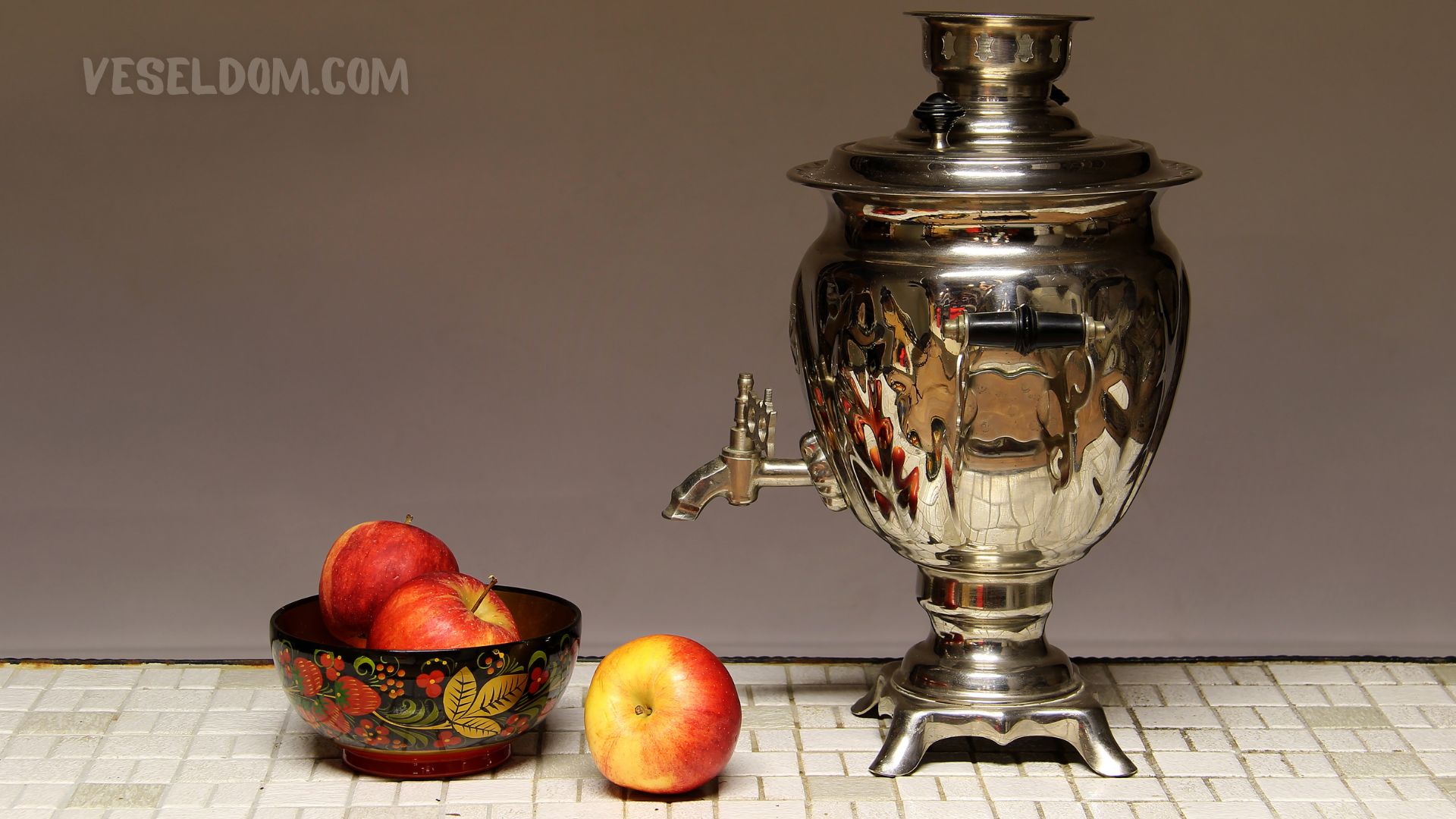
As a rule, any samovar consists of several parts:
- the wall is the base, the body, where water is poured;
- a jug is a container for the heating system. Previously, coal was located in the lower part, which lifted warm air up;
- a built-in pipe through which warm air came from the coal; today there is an electro-spiral;
- cap – latch for closing the jug;
- cover – to exclude moisture evaporation and premature cooling of water;
- burner – a stand for a teapot;
- vent – a hole on the lid for the release of excess steam;
- handle – for ease of use and a decorative accessory;
- repeik – a plate that provides fastening of the faucet;
- faucet – an element that provides water supply and performs an additional aesthetic function;
- key – an element for adjusting the water pressure;
- the neck is the lower part of the samovar;
- the pallet is the bottom, which provides greater stability.
Rules for cleaning a copper samovar from scale and rust
The first thing to do when starting to clean the samovar is to remove the accessories: handles, key, faucet. They should be put in a pan with water and soda ash, and then boiled for half an hour. Thus, the accessories will be cleaned of fat and scale, and will not interfere with cleaning the main product.
Vinegar, lemon, flour
In order to return the copper samovar to its former shine and remove scale from the inside, you can try to clean it with a composition that includes vinegar, lemon and flour . A thick slurry is applied to the container on both sides and cleaned with the rough surface of an ordinary dish sponge. The surface is washed with clean water and dried, and then rubbed to a shine with a soft cloth.
Importantly! Lemon and vinegar perfectly eat away the scum, but are also dangerous for the skin of the hands. Therefore, it is necessary to carry out cleaning in rubber gloves.
If the samovar is not so dirty, you can do without lemon. Flour, vinegar and coarse salt are mixed and both sides of the product are wiped with the resulting scrub. After cleaning, the samovar is rubbed with crumpled newspaper until it shines.
Simply wiping the surface with a slice of lemon will remove dirt and refresh the color. Heavier stains are cleaned with a hard sponge, and at the end they are rinsed with water and rubbed.
Importantly! If you use once a week to wipe the samovar with a piece of lemon as a preventive measure, then stronger means will not be needed for a long time.
Sometimes copper is so strongly oxidized that it cannot be used even by the most expensive means of purchase. Cleaning with acetic acid will help here . A rag is soaked in the solution and rubbed on the samovar. They wait for some time and wait for a reaction, and then repeat the procedure again. There is no need to clean off the gray, weak coating – the patina from ancient samovars, as it indicates that you have a rarity, an original.
Alcohol and sorrel juice
A brass samovar cleans the warehouse well with ammonia and sorrel juice. Both are mixed equally, applied in an even layer and wiped with a stiff sponge. Strongly abrasive devices cannot be used, as they scratch and spoil the brass layer.
Sorrel juice perfectly removes rust, corrodes any deposits of lime and dirt. Keeping oxalic acid for 10 minutes and subsequent cleaning with the addition of baking soda will be especially effective.
If the plaque is not too strong, you can simply wipe with ammonia, and then rinse with water and wipe dry until shiny.
Importantly! It should be remembered that brass does not tolerate moisture very well. Therefore, such samovars are not stored in damp places.
Fanta, Cola, Sprite
Carbonated drinks also clean scale well and even cope with rust. The drink is poured into the samovar and left until morning. In the morning, general cleaning begins: scale is removed from the inside, the product is also wiped from the outside and dirt is removed with a brush. Then rinse with tap water and rub with a soft cloth.
Potato peel and soda
Raw potato peels will help get rid of scale. They are thrown into a samovar with boiling water and boiled for an hour. Then leave to cool, and then pour. Make a new, soda solution with water and clean with a brush until it shines.
Citric acid
Citric acid removes scale very well. The classic recipe: fill the samovar with water, add a glass of citric acid powder and leave for several hours for the reaction. Then the same water is boiled and allowed to cool for several hours. The content is poured and the result is evaluated. In case of incomplete cleaning, the procedure is repeated.
The same recipe is used, replacing citric acid with acetic acid. The only drawback is the acrid smell, which is removed after some time.
Peculiarities of cleaning a samovar from different materials
Each material has its own characteristics that must be taken into account when cleaning.
- Porcelain and earthenware
Baking soda cleans such samovars well: for this, it is slightly moistened with water and turned into a thick paste, and then cleaned with a sponge.
- Gold plating
It is not recommended to clean products with gilded soda, as soda cleans the gilded plaque along with dirt. For gilding, sodium hypochlorite and chicken egg white, mixed in equal parts, are ideal. The mixture is applied, left overnight, and washed off in the morning. After everything, rub with a soft cloth until it shines.
Any products can be cleaned with highly abrasive products such as river sand, sandpaper or a wire scourer. They clean well, but at the same time leave multiple scratches that greatly spoil the appearance.
- Brass
Brass samovars are prone to rust, which can be cleaned using a mixture of tooth powder, distilled water and ammonia. All components are mixed and applied to the surface, waiting 2 hours for the reaction. Then everything is washed off with soda water and dried.
- Aluminum
Samovars made of pure aluminum can be cleaned with a solution of vinegar and alcohol with the addition of sodium tetraborate. The composition is applied, left for some time, and then cleaned together with impurities. The remains are washed off with water and dried.
- Nickel and chrome
These metals are not cleaned with acids, as samovars will lose their shine. It is best to use special pastes, or a solution with soda or salt. You can try to remove rust with fish oil: it is applied in an even layer and left for a day, and then removed.
Importantly! Goya paste is best used as a cleaning paste: it is applied, left for 24 hours, and then washed off. In some advanced cases, the procedure is repeated several times.
After cleaning, do not forget to keep the samovar in good condition. Regular care will help preserve the beauty of an antique item and make it a real family treasure.